Testing Emulator Example Notebook
This notebook shows code to run several performance metrics on a trained ps_emulator object. For demonstration purposes, all figures here were made using the final optimized emulator in Adamo et al (2026).
[ ]:
import torch
import numpy as np
import matplotlib.pyplot as plt
import matplotlib.colors as colors
import itertools

from mentat_lss.emulator import ps_emulator
from mentat_lss.utils import load_config_file, calc_avg_loss, delta_chi_squared, get_parameter_ranges, calc_chi2_statistics
[2]:
plt.rcParams['figure.facecolor'] = 'white'
plt.rcParams.update({'font.size': 11})
plt.rcParams["legend.frameon"] = False
Here are some plotting routine functions we will use later
[3]:
def make_heatmap(x, y, z, bins, median=True):
    x_new = np.linspace(np.amin(x), np.amax(x), bins+1)
    y_new = np.linspace(np.amin(y), np.amax(y), bins+1)
    z_new = np.zeros((bins,bins))
    for i in range(bins):
        for j in range(bins):
            if median == True: z_new[j,i] = np.median(z[(x >= x_new[i]) & (x < x_new[i+1]) & (y >= y_new[j]) & (y < y_new[j+1])])
            else: z_new[j,i] = np.mean(z[(x >= x_new[i]) & (x < x_new[i+1]) & (y >= y_new[j]) & (y < y_new[j+1])])

    return x_new, y_new, z_new

def make_diagonal(x, y, bins, median=True):
    x_new = np.linspace(np.amin(x), np.amax(x), bins+1)
    y_new = np.zeros(bins)
    for i in range(bins):
        if median == True: y_new[i] = np.median(y[(x >= x_new[i]) & (x <= x_new[i+1])])
        else: y_new[i] = np.mean(y[(x >= x_new[i]) & (x <= x_new[i+1])])
    return x_new[:bins], y_new

def plot_heatmap(params, data, label, extents, cmap, log_scale,
                 names, labels, median=False, save_str=""):

    params = params.copy()
    fig, axs = plt.subplots(len(names),len(names), figsize=(12,12), sharex="col")
    for i in range(len(names)):
        for j in range(len(names)):
            idx_i = pnames.index(names[i])
            idx_j = pnames.index(names[j])
            if i < j:
                axs[i][j].axis("off")
                continue
            if i == j:
                x, y = make_diagonal(params[:,idx_j], data, 25, median)
                axs[i][j].plot(x, y)
            else:
                X, Y, Z = make_heatmap(params[:,idx_j], params[:,idx_i], data, 25, median)
                if log_scale == True: img = axs[i,j].imshow(Z, aspect="auto", extent=(X[0], X[-1], Y[0], Y[-1]), cmap=cmap,
                                                      norm=colors.LogNorm(vmin=extents[0], vmax=extents[1]))
                else: img = axs[i,j].imshow(Z, aspect="auto", extent=(X[0], X[-1], Y[0], Y[-1]), cmap=cmap, vmin=extents[0], vmax=extents[1])
                axs[i,j].set_xlim(X[0] - (X[-1] - X[0]) * 0.05, X[-1] + (X[-1] - X[0]) * 0.05)
                axs[i,j].set_ylim(Y[0] - (Y[-1] - Y[0]) * 0.05, Y[-1] + (Y[-1] - Y[0]) * 0.05)

                axs[i,j].xaxis.set_ticks_position('both')
                axs[i,j].yaxis.set_ticks_position('both')

            axs[i,j].tick_params(direction="in")
            for item in ([axs[i,j].xaxis.label, axs[i,j].yaxis.label]):
                item.set_fontsize(15)

            #if i != j: axs[i][j].axhline(params_best[i], linestyle="--", c="black")
            #axs[i][j].axvline(params_best[j], linestyle="--", c="black")
            if i == len(names) - 1: axs[i][j].set_xlabel(labels[j])
            if j == 0 and i != 0: axs[i][j].set_ylabel(labels[i])
            #if j == 0 and i != 5:   axs[i][j].xaxis.set_ticklabels([])
            elif j != 0 and i == len(names)-1: axs[i][j].yaxis.set_ticklabels([])
            elif j != 0 and i != len(names)-1:
                #axs[i][j].xaxis.set_ticklabels([])
                axs[i][j].yaxis.set_ticklabels([])

    #axs[5][3].set_xticks([1,2,3,4])
    cbar_ax = fig.add_axes([0.96, 0.14, 0.039, 0.7])
    cbar = fig.colorbar(img, cax=cbar_ax)
    cbar.set_label(label, size=22)
    cbar.ax.tick_params(labelsize=18)
    plt.subplots_adjust(wspace=0, hspace=0, right=0.95)

    if save_str!="": plt.savefig(save_str, dpi=300, bbox_inches='tight')
As a first step, we load in our trained emulator and the testing dataset in the following cells.
[4]:
# load the network
repo_dir = "/Users/JoeyA/Research/SPHEREx/mentat-lss/"
emulator_dir = repo_dir+"emulators/stacked_transformer_2t_2z_hypersphere/"
training_dir = repo_dir+"../../Data/SPHEREx-Data/training_set_eft_2t_2z_hypersphere/"
cosmo_dir = repo_dir + "configs/cosmo_pars/cosmo_pars_2t_2z.yaml"


emulator = ps_emulator(emulator_dir, "eval")
num_networks = emulator.num_zbins * emulator.num_spectra

# used in heatmap plotting routine
config_dict = load_config_file(emulator_dir+"config.yaml")
cosmo_dict = load_config_file(cosmo_dir)
#cosmo_dict = load_config_file(input_dir+config_dict["cosmo_dir"])
pnames, bounds = get_parameter_ranges(cosmo_dict)
[5]:
# load the test dataset
test_data = emulator.load_data("testing", 1., False, training_dir)
test_loader = torch.utils.data.DataLoader(test_data, batch_size=config_dict["batch_size"], shuffle=True)
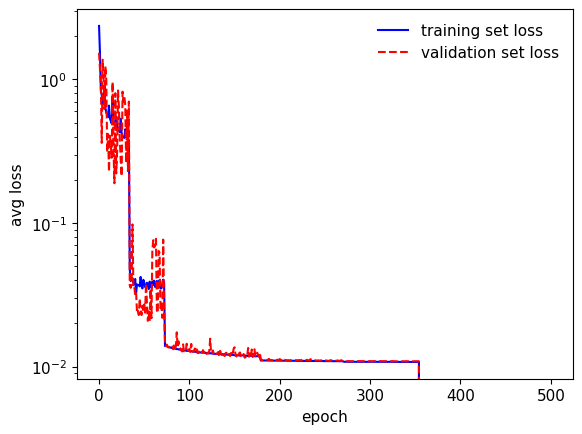
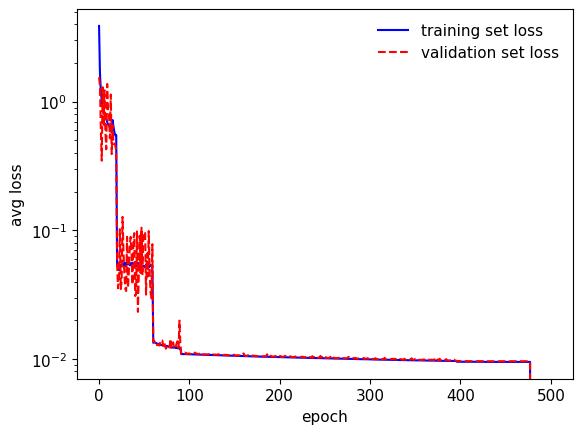
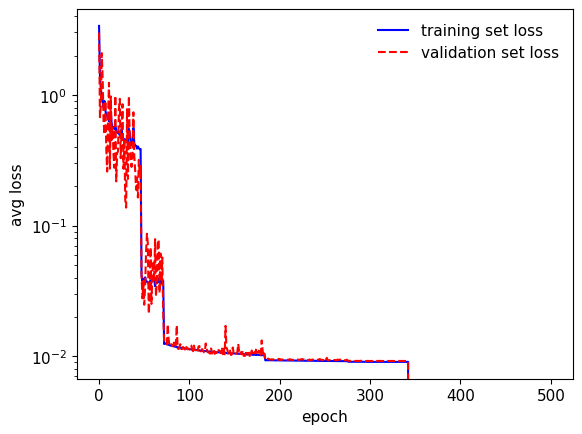
Loss Function Stats
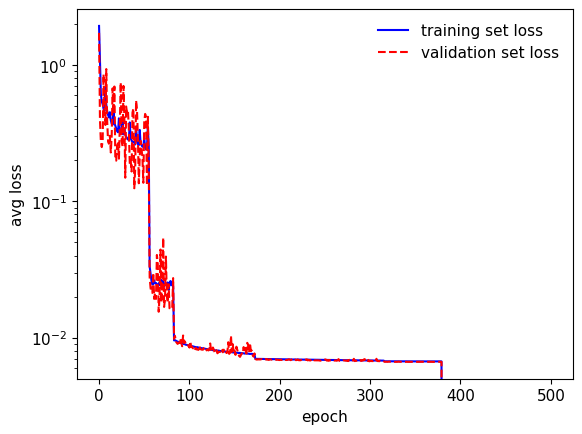
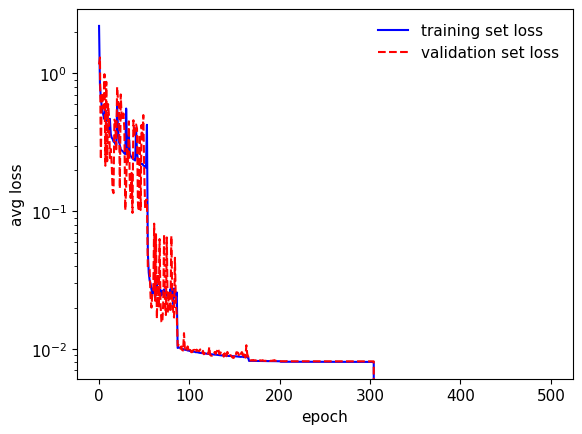
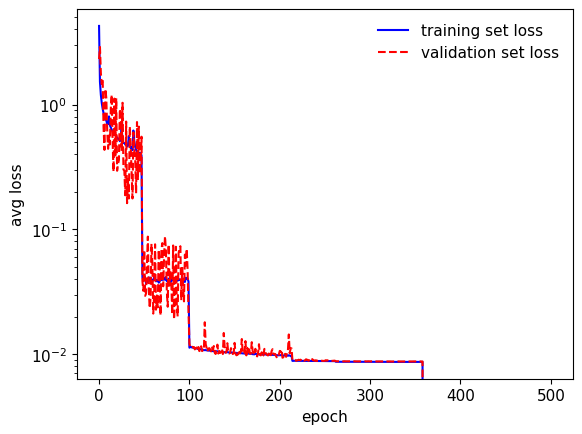
The following cell displays loss function stats saved during training, and calculates the average loss value for the testing dataset.
[6]:
# make plots showing training / validation loss during training
test_loss = calc_avg_loss(emulator, test_loader, emulator.loss_function)

for (ps, z) in itertools.product(range(emulator.num_spectra), range(emulator.num_zbins)):
    training_data = torch.load(emulator_dir+"training_statistics/train_data_"+str(ps)+"_"+str(z)+".dat")

    #epochs = range(min(np.where(training_data[0] == 0)[0][0], training_data.shape[1]))
    epochs = range(training_data.shape[1])
    num_epochs = epochs[-1]+1
    train_loss = training_data[0,:num_epochs]
    valid_loss = training_data[1,:num_epochs]
    learning_rate = training_data[2,:num_epochs]
    print("Net [{:d}, {:d}], Total # of epochs    = {:0.0f}".format(ps, z, len(train_loss)))
    print("Net [{:d}, {:d}], Best training loss   = {:0.4f}".format(ps, z, torch.amin(train_loss)))
    print("Net [{:d}, {:d}], Best validation loss = {:0.4f}".format(ps, z, torch.amin(valid_loss)))
    print("Net [{:d}, {:d}], Average test loss    = {:0.4f}\n".format(ps, z, test_loss[ps][z]))

    plt.figure()
    plt.plot(epochs, train_loss, c="blue", label="training set loss")
    plt.plot(epochs, valid_loss, c="red", ls="--", label="validation set loss")
    plt.xlabel("epoch")
    plt.ylabel("avg loss")
    plt.yscale("log")
    plt.legend()
Net [0, 0], Total # of epochs    = 500
Net [0, 0], Best training loss   = 0.0000
Net [0, 0], Best validation loss = 0.0000
Net [0, 0], Average test loss    = 0.0068

Net [0, 1], Total # of epochs    = 500
Net [0, 1], Best training loss   = 0.0000
Net [0, 1], Best validation loss = 0.0000
Net [0, 1], Average test loss    = 0.0081

Net [1, 0], Total # of epochs    = 500
Net [1, 0], Best training loss   = 0.0000
Net [1, 0], Best validation loss = 0.0000
Net [1, 0], Average test loss    = 0.0088

Net [1, 1], Total # of epochs    = 500
Net [1, 1], Best training loss   = 0.0000
Net [1, 1], Best validation loss = 0.0000
Net [1, 1], Average test loss    = 0.0108

Net [2, 0], Total # of epochs    = 500
Net [2, 0], Best training loss   = 0.0000
Net [2, 0], Best validation loss = 0.0000
Net [2, 0], Average test loss    = 0.0096

Net [2, 1], Total # of epochs    = 500
Net [2, 1], Best training loss   = 0.0000
Net [2, 1], Best validation loss = 0.0000
Net [2, 1], Average test loss    = 0.0090
Delta chi2 stats
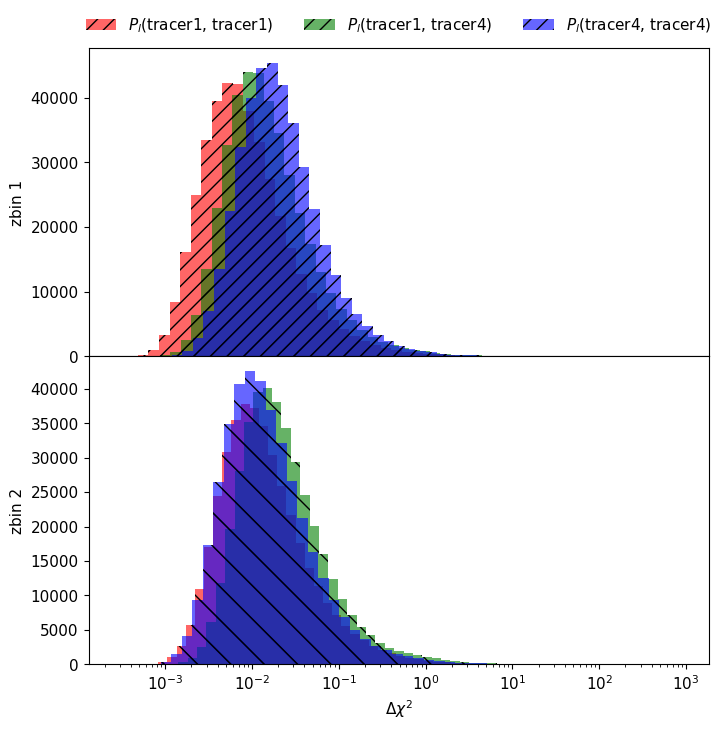
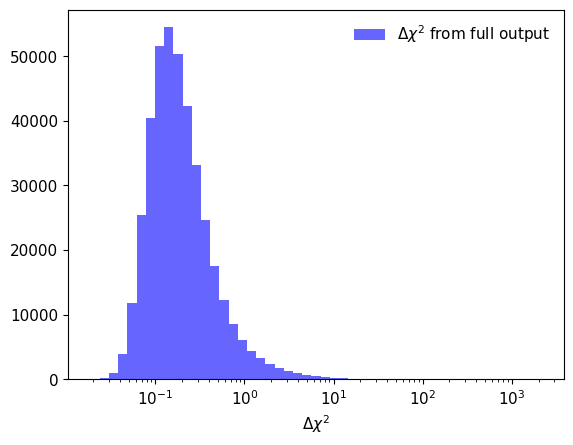
These cells calculate the main performance statistic we use for emulator performance, mainly \(\Delta \chi^2\) given by the folloiwng equation,
Since we have multiple sub-networks, we can calculate this quantity for each individual bin, or the full output.
[ ]:
delta_chi2, delta_chi2_combined = calc_chi2_statistics(emulator, test_loader, calc_partial=True, print_progress=True)
100%|██████████| 401/401 [01:21<00:00, 4.94it/s]
[8]:
# Plot chi2 histograms for each individual network
labels=[r"$P_l$(tracer1, tracer1)", r"$P_l$(tracer1, tracer4)", r"$P_l$(tracer4, tracer4)"]
cmap = ["red", "green", "blue"]
style = ["//", "\\"]

fig, axs = plt.subplots(2, 1, figsize=(8,8), sharex=True)
for (ps, z) in itertools.product(range(emulator.num_spectra), range(emulator.num_zbins)):
    print("net [{:d}, {:d}], mean chi2 error = {:0.3f}".format(ps, z, np.mean((delta_chi2)[ps, z])))
    print("net [{:d}, {:d}], median chi2 error = {:0.3f}".format(ps, z, np.median(delta_chi2[ps, z])))
    axs[z].hist(delta_chi2[ps, z], bins=np.geomspace(np.amin(delta_chi2[ps, z]), np.amax(delta_chi2[ps, z]), 50), alpha=0.6,
                facecolor=cmap[ps], hatch=style[z], label=labels[ps])

axs[0].legend(loc="upper center", ncol=3, bbox_to_anchor=(0.5, 1.15))
axs[0].set_ylabel("zbin 1")
axs[1].set_ylabel("zbin 2")
plt.xscale("log")
plt.xlabel(r"$\Delta \chi^2$")
plt.subplots_adjust(hspace=0)
#plt.savefig("../plots/delta_chi2_histogram.png", dpi=300, bbox_inches='tight')
net [0, 0], mean chi2 error = 0.031
net [0, 0], median chi2 error = 0.007
net [0, 1], mean chi2 error = 0.042
net [0, 1], median chi2 error = 0.012
net [1, 0], mean chi2 error = 0.049
net [1, 0], median chi2 error = 0.013
net [1, 1], mean chi2 error = 0.071
net [1, 1], median chi2 error = 0.019
net [2, 0], mean chi2 error = 0.060
net [2, 0], median chi2 error = 0.019
net [2, 1], mean chi2 error = 0.051
net [2, 1], median chi2 error = 0.013
[9]:
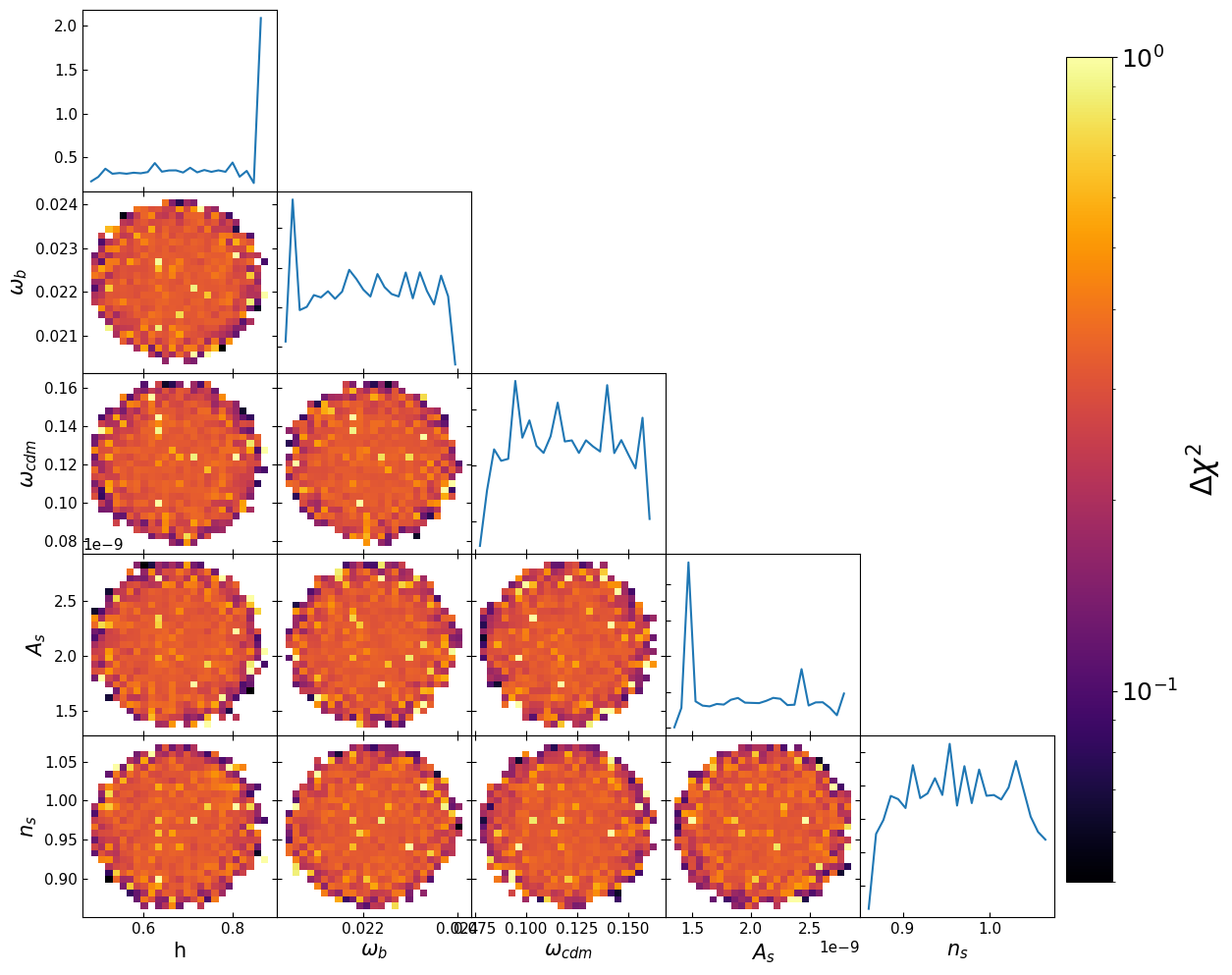
# plot delta chi2 heatmap
# @Grace these plots are the main ones we're using to quantify network performance

print("mean combined chi2 error = {:0.3f}".format(np.mean(delta_chi2_combined)))
print("median combined chi2 error = {:0.3f}".format(np.median(delta_chi2_combined)))

names = ['h', "ombh2", "omch2", "As", "ns"]
labels = [r"h", r"$\omega_{b}$", r"$\omega_{cdm}$", r"$A_s$", r"$n_s$"]

plt.hist(delta_chi2_combined, bins=np.geomspace(np.amin(delta_chi2_combined), np.amax(delta_chi2_combined), 50), alpha=0.6,
                facecolor="blue", hatch="", label=r"$\Delta \chi^2$ from full output")
plt.xscale("log")
plt.xlabel(r"$\Delta \chi^2$")
plt.legend()
#plt.savefig("../plots/chi2-histogram-combined.png", dpi=300)

cmap="inferno"
#extents = [2e6, 1e10]
extents = [5e-2, 1e0]
save_str = "../plots/delta_chi2_heatmap.png"
plot_heatmap(test_data.params.to("cpu").detach().numpy(), delta_chi2_combined, r"$\Delta \chi^2$",
             extents, cmap, True, names, labels, median=False, save_str="")
mean combined chi2 error = 0.352
median combined chi2 error = 0.167
/Users/JoeyA/miniconda3/envs/mentat_lss/lib/python3.11/site-packages/numpy/core/fromnumeric.py:3504: RuntimeWarning: Mean of empty slice.
  return _methods._mean(a, axis=axis, dtype=dtype,
/Users/JoeyA/miniconda3/envs/mentat_lss/lib/python3.11/site-packages/numpy/core/_methods.py:129: RuntimeWarning: invalid value encountered in scalar divide
  ret = ret.dtype.type(ret / rcount)
/Users/JoeyA/miniconda3/envs/mentat_lss/lib/python3.11/site-packages/numpy/core/fromnumeric.py:3504: RuntimeWarning: Mean of empty slice.
  return _methods._mean(a, axis=axis, dtype=dtype,
/Users/JoeyA/miniconda3/envs/mentat_lss/lib/python3.11/site-packages/numpy/core/_methods.py:129: RuntimeWarning: invalid value encountered in scalar divide
  ret = ret.dtype.type(ret / rcount)
/Users/JoeyA/miniconda3/envs/mentat_lss/lib/python3.11/site-packages/numpy/core/fromnumeric.py:3504: RuntimeWarning: Mean of empty slice.
  return _methods._mean(a, axis=axis, dtype=dtype,
/Users/JoeyA/miniconda3/envs/mentat_lss/lib/python3.11/site-packages/numpy/core/_methods.py:129: RuntimeWarning: invalid value encountered in scalar divide
  ret = ret.dtype.type(ret / rcount)
/Users/JoeyA/miniconda3/envs/mentat_lss/lib/python3.11/site-packages/numpy/core/fromnumeric.py:3504: RuntimeWarning: Mean of empty slice.
  return _methods._mean(a, axis=axis, dtype=dtype,
/Users/JoeyA/miniconda3/envs/mentat_lss/lib/python3.11/site-packages/numpy/core/_methods.py:129: RuntimeWarning: invalid value encountered in scalar divide
  ret = ret.dtype.type(ret / rcount)
/Users/JoeyA/miniconda3/envs/mentat_lss/lib/python3.11/site-packages/numpy/core/fromnumeric.py:3504: RuntimeWarning: Mean of empty slice.
  return _methods._mean(a, axis=axis, dtype=dtype,
/Users/JoeyA/miniconda3/envs/mentat_lss/lib/python3.11/site-packages/numpy/core/_methods.py:129: RuntimeWarning: invalid value encountered in scalar divide
  ret = ret.dtype.type(ret / rcount)
/Users/JoeyA/miniconda3/envs/mentat_lss/lib/python3.11/site-packages/numpy/core/fromnumeric.py:3504: RuntimeWarning: Mean of empty slice.
  return _methods._mean(a, axis=axis, dtype=dtype,
/Users/JoeyA/miniconda3/envs/mentat_lss/lib/python3.11/site-packages/numpy/core/_methods.py:129: RuntimeWarning: invalid value encountered in scalar divide
  ret = ret.dtype.type(ret / rcount)
/Users/JoeyA/miniconda3/envs/mentat_lss/lib/python3.11/site-packages/numpy/core/fromnumeric.py:3504: RuntimeWarning: Mean of empty slice.
  return _methods._mean(a, axis=axis, dtype=dtype,
/Users/JoeyA/miniconda3/envs/mentat_lss/lib/python3.11/site-packages/numpy/core/_methods.py:129: RuntimeWarning: invalid value encountered in scalar divide
  ret = ret.dtype.type(ret / rcount)
Test individual power spectra
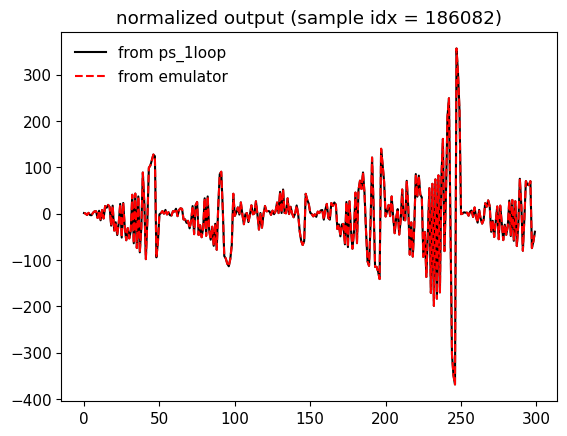
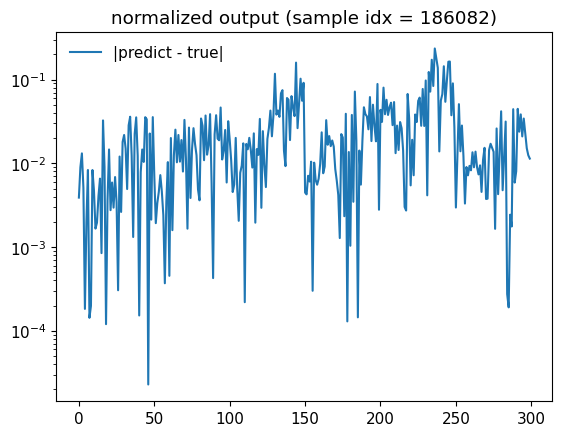
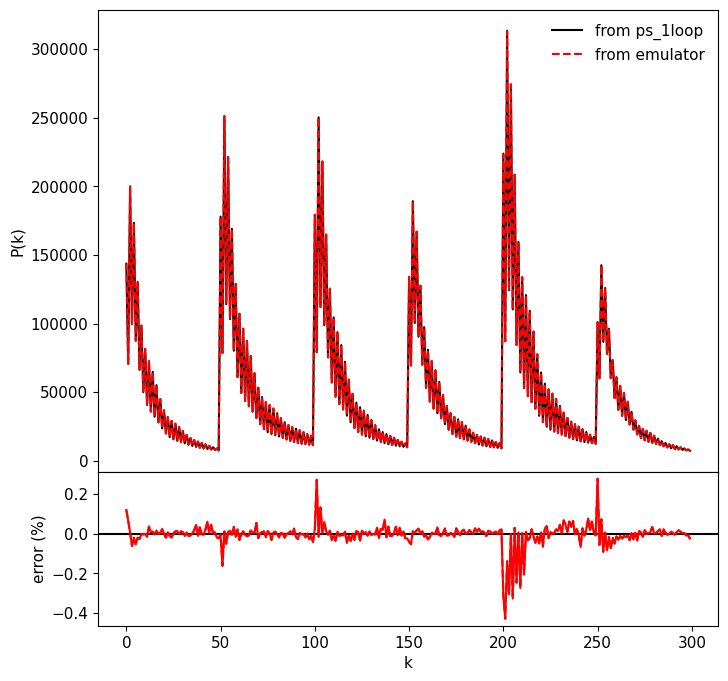
Finally, it can be helpful to take a look at individual outputs to see how the emulator is doing on a single run-through.
[13]:
idx = np.random.randint(len(test_data))
print("Stats for index {:d}".format(idx))

params = test_data[idx][0].to("cpu")
pk_emu = emulator.get_power_spectra(params.detach().numpy(), False, False)
pk_emu_raw = emulator.get_power_spectra(params.detach().numpy(), False, True)[0]
pk_raw = test_data.get_normalized_galaxy_power_spectra(idx)
pk_true = test_data.get_true_galaxy_power_spectra(idx, emulator.ps_fid,
                                                emulator.sqrt_eigvals,
                                                emulator.Q,
                                                emulator.Q_inv).detach().numpy()
print("input parameters:", params)
error = 100 * (pk_emu - pk_true) / pk_true

chi2_full = delta_chi_squared(pk_emu, pk_true, emulator.invcov_full, False)
print("Combined Delta chi2 = {:0.3f}".format(chi2_full))

#Calculate delta chi2 for each network seperately
d_chi2_sum = 0
for (ps, z) in itertools.product(range(emulator.num_spectra), range(emulator.num_zbins)):
    d_chi2 = delta_chi_squared(pk_emu_raw[ps, z].unsqueeze(0), pk_raw[ps, z].unsqueeze(0), emulator.invcov_blocks, True)
    d_chi2_sum += d_chi2
    print("Net [{:d}, {:d}], Delta chi2 = {:0.3f}".format(ps, z, d_chi2))
print("Sum of Delta chi2 = {:0.3f}".format(d_chi2_sum))

print("Average error per bin = {:0.2f}%".format(np.mean(abs(error))))

plt.figure()
plt.title("normalized output (sample idx = "+str(idx)+")")
plt.plot(pk_raw.flatten(), c="black", label="from ps_1loop")
plt.plot(pk_emu_raw.flatten(), c="red", ls="--", label="from emulator")
plt.legend()

plt.figure()
plt.title("normalized output (sample idx = "+str(idx)+")")
plt.plot(abs(pk_raw - pk_emu_raw).flatten(), label="|predict - true|")
plt.yscale("log")
plt.legend()

fig, axs = plt.subplots(2, 1, figsize=(8, 8), sharex=True, gridspec_kw={'height_ratios': [3, 1]})

axs[0].plot(pk_true.flatten(), c="black", label="from ps_1loop")
#axs[0].plot(pk_true[:,0].flatten(), c="green", ls="--")
axs[0].plot(pk_emu.flatten(),  c="red", ls="--", label="from emulator")
axs[1].axhline(0, c="black")
axs[1].plot(error.flatten(), c="red")
axs[1].plot(error.flatten(), c="red", ls="--")

axs[1].set_xlabel("k")
axs[0].set_ylabel("P(k)")
axs[1].set_ylabel("error (%)")
axs[0].legend()
fig.subplots_adjust(hspace=0)
Stats for index 186082
input parameters: tensor([ 7.7051e-01,  2.1514e-02,  9.8107e-02,  2.0968e-09,  9.5865e-01,
         1.3389e+00,  1.7207e+00,  1.7048e+00,  1.2258e+00, -1.2775e+00,
        -1.9652e+00, -8.1640e-01, -1.3647e+00, -2.6730e-01, -7.8944e-01,
        -4.9422e-01, -5.5165e-01])
Combined Delta chi2 = 1.011
Net [0, 0], Delta chi2 = 0.012
Net [0, 1], Delta chi2 = 0.018
Net [1, 0], Delta chi2 = 0.105
Net [1, 1], Delta chi2 = 0.035
Net [2, 0], Delta chi2 = 0.328
Net [2, 1], Delta chi2 = 0.019
Sum of Delta chi2 = 0.518
Average error per bin = 0.03%
[11]:
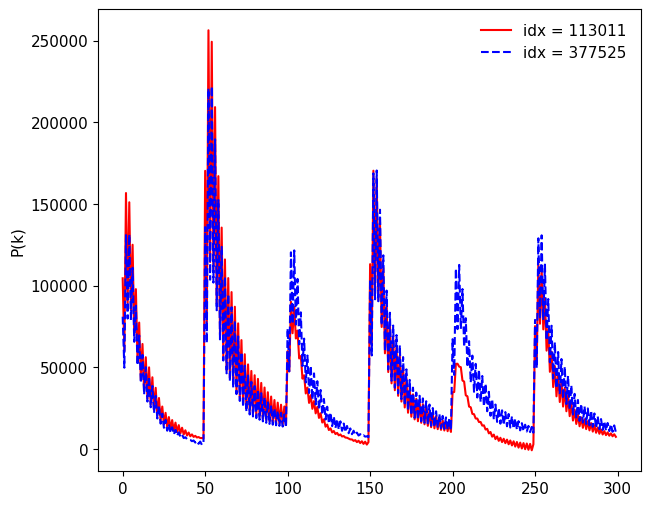
# Sanity Check: make sure two different samples to see if the network outputs different results
idx_1 = np.random.randint(len(test_data))
idx_2 = np.random.randint(len(test_data))

params = test_data[idx_1][0].to("cpu")
pk_emu_1 = emulator.get_power_spectra(params.detach().numpy())
params = test_data[idx_2][0].to("cpu")
pk_emu_2 = emulator.get_power_spectra(params.detach().numpy())

fig, axs = plt.subplots(1, 1, figsize=(7, 6), sharex=True)

axs.plot(pk_emu_1.flatten(),  c="red", label="idx = " + str(idx_1))
axs.plot(pk_emu_2.flatten(),  c="blue", ls="--", label="idx = " + str(idx_2))
#axs[0].plot(k, data_vector[25:], c="blue", ls="--")

axs.set_ylabel("P(k)")
axs.legend()
fig.subplots_adjust(hspace=0)